

UPP: The Jackal Never Hunts Alone: Child Protection as Community Defense
The Jackal Never Hunts Alone: Child Protection as Community Defense

There are a lot of dangers in the concrete jungle, and people who prey on children are among them. But we should be clear about what kind of predator we’re dealing with. This isn’t a lion. It’s a jackal. It doesn’t win by strength. It wins by isolation, by finding the child who’s alone too much, who doesn’t have the words for what’s happening, and who doesn’t believe anyone would listen if they did. The jackal is only dangerous until the lions, tigers and bears walk into the room. And now there are wolf packs too, our YNs, young people who’ve decided this won’t happen on their block.
That’s the image. Now let’s look at where the jackal actually lives.
The Jungle Doesn’t Stop at the Door
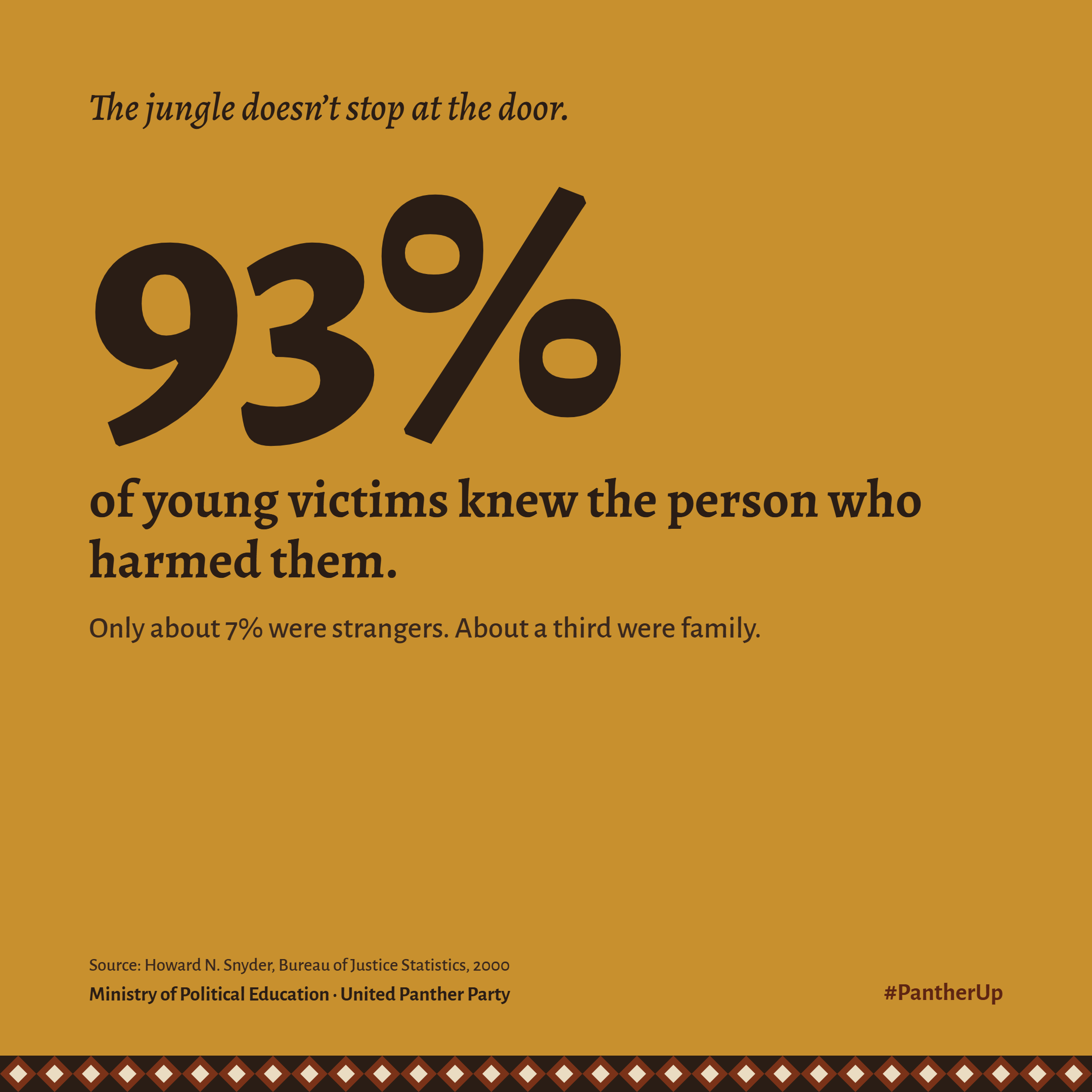
We tend to picture the danger out there: the stranger in the van, the man lurking by the park. That picture is comfortable because it keeps the threat outside. The numbers say otherwise. Federal data analyzed by Howard Snyder for the Bureau of Justice Statistics in “Sexual Assault of Young Children as Reported to Law Enforcement” found that roughly 93% of young victims knew the person who harmed them. Strangers made up about 7%. Family members alone accounted for about a third.
The concrete jungle extends into the huts. The jackal is the uncle, the family friend, the coach, the man who’s dating someone’s mama, the person with a key to the house. He isn’t lurking at the edge of the village. He’s invited to dinner. The walls of the hut do his isolating for him, and the trust of the family is his cover.
Any defense built around strangers misses most of the threat. If we’re serious about protecting children, our analysis has to start inside the home, not outside it.
Isolation Is the Method
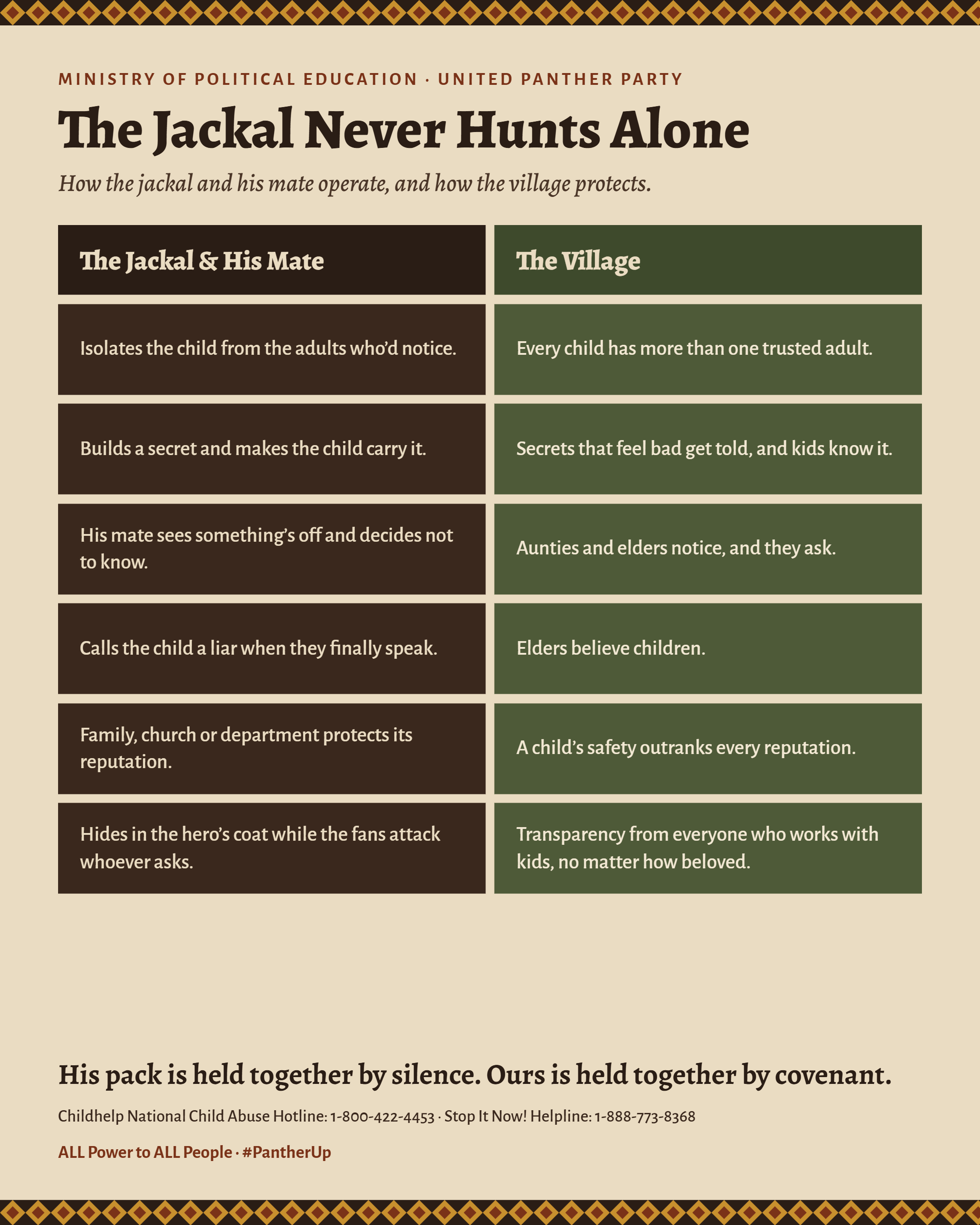
Judith Herman, in Trauma and Recovery, describes how abusers depend on secrecy and silence, and how they work to make the victim’s account unbelievable before it’s ever spoken. That’s the jackal’s whole strategy. Separate the child from the adults who’d notice. Build a secret. Make the child feel responsible for keeping it. Count on the family choosing comfort over looking hard at someone they love.
Take away the isolation and most of the jackal’s power goes with it. A child with several trusted adults, who knows their body belongs to them, who’s been taught that secrets that feel bad get told, and who’s surrounded by elders who’ll actually believe them, is a child the jackal can’t easily reach.
The Jackal’s Mate
A jackal doesn’t hunt alone. It hunts with its mate, and the pair holds its territory together. The person who harms a child almost never operates without help either. The help just rarely looks like a partner in crime. It looks like family.
It’s the parent who notices something’s off and decides not to know. It’s the grandmother who tells the child to stop telling lies about her son. It’s the relatives who say “we handle this in the family” and then handle nothing. It’s the church that quietly moves a man to another congregation, the school that lets a teacher resign instead of reporting him, the coach’s friends who close ranks. Sometimes it’s an actual co-offender. More often it’s people who’d never touch a child themselves but who protect the one who does.
Jennifer Freyd’s work gives names to these patterns. In Blind to Betrayal, written with Pamela Birrell, she describes how people who depend on an abuser, emotionally or materially, often can’t let themselves see the abuse, because seeing it would cost them too much. She also named the response so many survivors meet when they finally speak: deny the harm, attack the person who disclosed it, and reverse the roles so the abuser becomes the victim. And in “Institutional Betrayal,” written with Carly Parnitzke Smith, she showed how institutions deepen the damage when they protect their reputation instead of the person who was harmed.
That’s the jackal’s mate. Isolation is the method, but enablers are what keep the isolation in place. A child who tells and gets called a liar learns that telling doesn’t work, and the jackal goes on hunting with the whole household standing guard.
This is why community defense can’t stop at watching for the predator. We have to watch the silence around him too. Covering for an abuser is taking a side, and it’s the jackal’s side.
The Jackal in Plain Sight
Some jackals don’t hide at all. They hunt in the open, wearing the coat of the protector.
Anna Salter, in Predators, writes about how many offenders spend years building reputations as the most trustworthy people in town, and how that reputation becomes their best defense. They don’t just groom the child. They groom the whole village. The pastor everybody loves. The youth coach who never misses a game. The man in uniform who hands out gifts and shows up for the kids. When his kindness to children is public, filmed, posted and applauded, his access looks like a virtue instead of a risk, and anyone who questions it looks like the villain.
We want to be careful here. Plenty of people who show up for children are exactly who they appear to be, and our communities need more of them, not fewer. The point isn’t that kindness is suspicious. The point is that image is never a substitute for accountability. A public persona of care doesn’t earn anyone unsupervised access to our children, and it doesn’t exempt anyone from scrutiny.
Watch how the mate behaves when the coat is the protector’s coat. Fans flood the comments to defend him. Institutions guard their files more fiercely than they guard children, and the people asking for the record get treated as the threat. That’s the same pattern Freyd described, just with a bigger audience. A person with nothing to hide, and an institution with nothing to hide, can stand in the light. When the response to every question is to close ranks and attack the one asking, the community should take note of what’s being protected.
When the Lions Walk In
We understand the energy behind the wolf packs. Our young people are tired of watching harm go unanswered, and the instinct to protect is a righteous one. But we’ve watched what happens when that energy turns into street justice. Wrong people get beaten over a rumor. Real cases fall apart because the evidence got contaminated or the person got tipped off and disappeared. And our young men catch assault and kidnapping charges that feed them straight into the cage, while the actual abuser walks free.
There’s a deeper problem too. Street justice can’t reach the uncle, and it can’t reach the beloved man the whole town would line up to defend. The pack is looking outward for a stranger, and the child who most needs protecting often can’t speak up precisely because the person harming them is someone the pack would never suspect. Vengeance after the fact doesn’t touch the method. Presence does.
So we say to the YNs: we need you, and we need you pointed at the right target. Be the visible older brother on the block. Mentor the kids who’re always outside alone. Know which households are struggling. Be the safe adult a child can run to. That’s how a wolf pack actually breaks the jackal’s method, by making sure no child in your territory is ever isolated.
Protection Is Dual Power Infrastructure
Dr. Huey P. Newton called the Party’s community programs survival pending revolution. Feeding children, testing for sickle cell, escorting elders: these weren’t charity. They were proof that communities could meet their own needs and defend their own people. Protecting children from sexual harm belongs in that same tradition. It’s dual power infrastructure, and it has to be built on purpose.
The Black Feminist pillar of our work has carried this question further than anyone. Organizers whose writing was gathered in The Revolution Starts at Home, edited by Ching-In Chen, Jai Dulani and Leah Lakshmi Piepzna-Samarasinha, and in INCITE!’s Color of Violence anthology, have insisted for years that a movement which ignores harm inside its own homes and organizations isn’t a liberation movement at all. The collective generationFIVE, in “Toward Transformative Justice,” framed child sexual abuse as a community problem requiring community response, one that puts the child’s safety first and refuses to let silence protect the abuser.
Mia Mingus and the Bay Area Transformative Justice Collective gave us a practical tool: pods. A pod is the circle of people a child, or an adult, can actually turn to when something’s wrong. Mapping those pods tells us who’s covered and who isn’t. A child with an empty pod is a child the jackal can find.
None of this means keeping a child near someone who’s harming them, and none of it means refusing outside help when a child’s safety demands it. Child advocacy centers, prevention lines like Stop It Now!, and trained advocates are part of the infrastructure too. Community accountability exists to protect the child, never to protect the family’s reputation, the church’s reputation, or the department’s.
In practice, this looks like households where nothing gets kept from the elders. It looks like every child having more than one adult they can go to. It looks like aunties and grandmothers who notice when a child goes quiet around a certain cousin, and who ask. It looks like a community that expects transparency from anyone who works with its children, no matter how beloved. And it looks like a single unbreakable rule: “he’s family” never outranks what a child says, and neither does “he’s a hero.”
The Hardest Part
Our villages rarely fail children from lack of strength. We fail them because we don’t want to look. Seeing the jackal in the hut means being willing to see danger in someone we love, someone we grew up with, someone who’s sat at our table for years, someone the whole town celebrates. That’s the real test of whether we mean it when we say we protect our own.
The lions, tigers and bears aren’t coming from outside. They have to be us: the elders, the aunties, the neighbors, the YNs, all of us present and paying attention in every hut on the block. The jackal never hunts alone. His pack is held together by silence, shame and spectacle. Ours has to be held together by covenant, a binding promise that no child among us will ever have to choose between telling the truth and keeping their family.
Ministry of Political Education, United Panther Party
ALL Power to ALL People.
#PantherUp #DecolonizeYourMind #LandBack
Sources and Further Reading
Howard N. Snyder, “Sexual Assault of Young Children as Reported to Law Enforcement: Victim, Incident, and Offender Characteristics,” Bureau of Justice Statistics, U.S. Department of Justice, 2000.
Judith Herman, Trauma and Recovery: The Aftermath of Violence, from Domestic Abuse to Political Terror, Basic Books, 1992.
Jennifer J. Freyd and Pamela J. Birrell, Blind to Betrayal: Why We Fool Ourselves We Aren’t Being Fooled, Wiley, 2013.
Carly Parnitzke Smith and Jennifer J. Freyd, “Institutional Betrayal,” American Psychologist, vol. 69, no. 6, 2014.
Anna C. Salter, Predators: Pedophiles, Rapists, and Other Sex Offenders: Who They Are, How They Operate, and How We Can Protect Ourselves and Our Children, Basic Books, 2003.
generationFIVE, “Toward Transformative Justice: A Liberatory Approach to Child Sexual Abuse and Other Forms of Intimate and Community Violence,” 2007.
Mia Mingus, “Pods and Pod Mapping Worksheet,” Bay Area Transformative Justice Collective, 2016.
Ching-In Chen, Jai Dulani and Leah Lakshmi Piepzna-Samarasinha, eds., The Revolution Starts at Home: Confronting Intimate Violence Within Activist Communities, South End Press, 2011; AK Press, 2016.
INCITE! Women of Color Against Violence, ed., Color of Violence: The INCITE! Anthology, South End Press, 2006.
David Hilliard and Donald Weise, eds., The Huey P. Newton Reader, Seven Stories Press, 2002.
Stop It Now!, prevention resources and confidential helpline, stopitnow.org.
Darkness to Light, child sexual abuse prevention training and resources, d2l.org.


No comments
You are welcome to email your tips, corrections and/or comments to: aidcommission@gmail.com please indicate if you wish to remain anonymous or otherwise. We will post your comment without edit.